
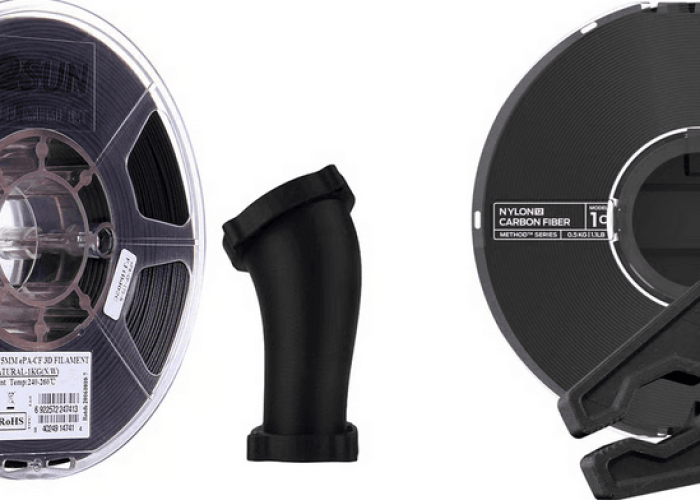

Confused about choosing filaments? This updated guide breaks down each type - from everyday PLA to high-performance PEEK - so you can print smarter. Filament 3D printers
| Filament | Main use | Mechanical resistance (indicative) |
|---|---|---|
| PLA (Polylactic Acid) | Rapid prototypes, decorative objects, non-functional parts | Low-Medium |
| PETG | Functional parts, components with moderate impact and chemical resistance | Environment |
| ABS | Housings, mechanical parts, functional prototypes | Medium-High |
| ASA | Outer parts (UV resistance), outer casings | Medium-High |
| TPU / TPE (flexible) | Seals, rollers, flexible parts, protections | Medium (high elasticity) |
| Nylon (PA6 / PA12) | Functional mechanical parts, gears, wear parts | High |
| PC (Polycarbonate) | Structural parts requiring thermal and impact resistance | High |
| CF-filled (PLA/NYLON/PC + carbon fiber) | Rigid parts, industrial/functional use (increased rigidity) | Very tall |
| PP (Polypropylene) | Low chemical impact/low wear parts, lightweight flexible parts | Environment |
| HIPS (support / final parts) | Support material (solvent-dissolvable) or simple parts | Low-Medium |
| PVA (soluble carrier) | Soluble support material for complex geometries | Low |
| PEEK (Polyetheretherketone) | Industrial/medical/aviation applications - high temperatures | Very tall |
| PEI / ULTEM | Components for aerospace and high-temp applications | Very tall |
Buying a 3D printer opens the door to a world of possibilities. Whether it's something functional, like a doorknob, or something fun, like board game miniatures, there's one common element that ties them all together: 3D printer filament. If you don't know the difference between PLA and ABS, or if you're not sure whether you need nylon or polypropylene, you've come to the right place.
Below, we provide you with an easy-to-understand overview (with all the essential and useful facts) of all the common types of 3D printer filament you may encounter. From fun materials like color-changing PLA to tough materials like carbon fiber-reinforced polypropylene, we show you what to use and how to use it. Filament 3D printers
Whether you're printing PLA cosplay armor, impact-resistant ABS parts or flexible TPU components, this guide will help you choose the right material and get the best possible results. Filament is serious business. It's estimated that over a billion dollars worth of filament will be sold by 2025, but not all of it is worth your money.
Let's take a look at all types of 3D printing filaments and find out which ones are right for your next project. Filament 3D Printers
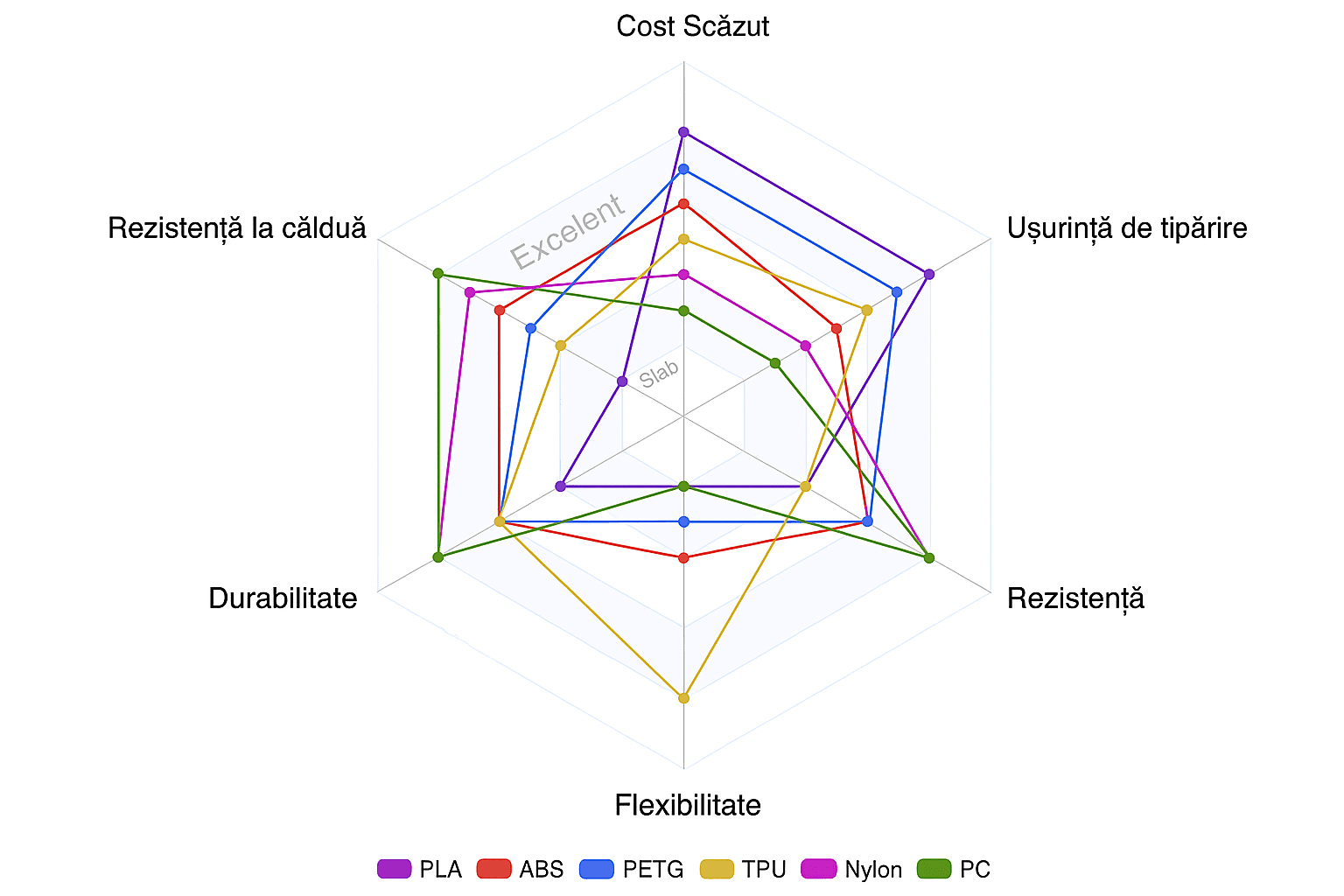
There are six polymers most used in 3D printing: PLA, ABS, PETG, TPU, nylon and PC. You may not need more than these and, although figures vary, it's estimated that 501TPTP3T of the filament market is accounted for by PLA, which has a wide range of properties and types. In this first category, we present the six most widely used 3D printer filaments, all popular for their specific physical properties.
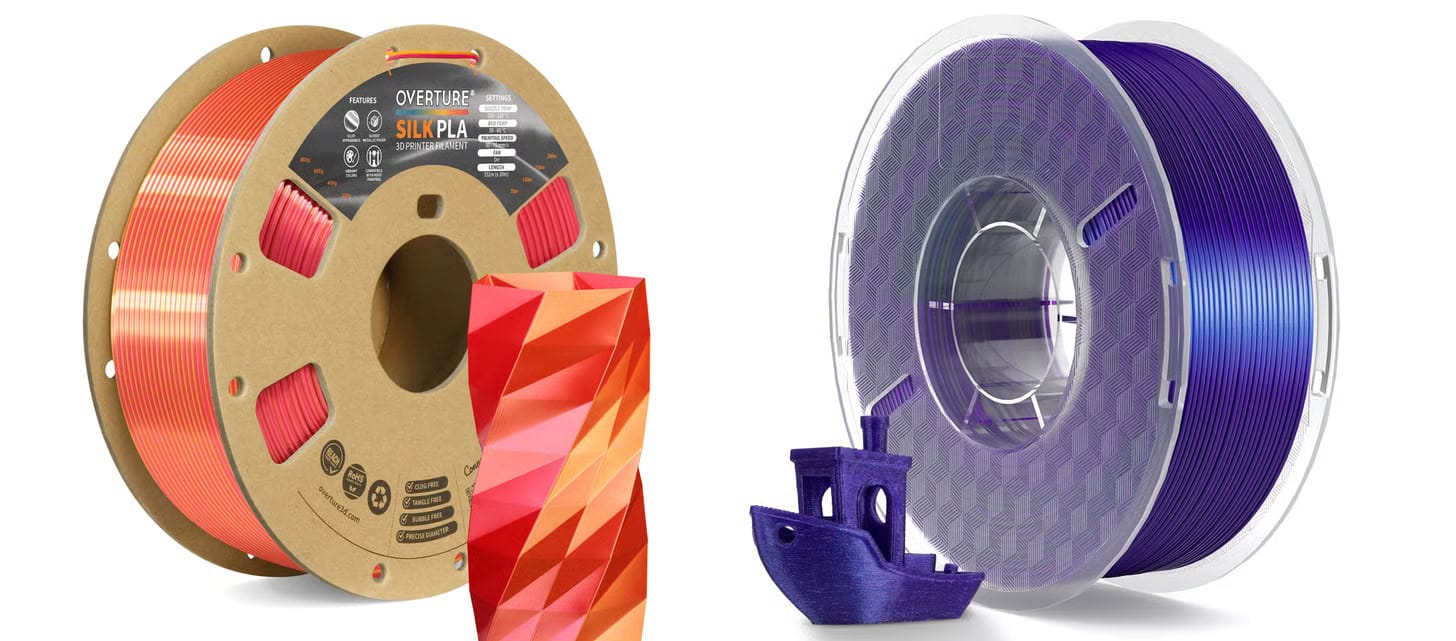
In mainstream 3D printing, polylactic acid (PLA) is king. Though it's often compared to ABS - probably next in line for the throne - PLA is easily the most popular type of filament for 3D printers, and for good reason: it's easy to print on almost any printer, is available in a wide variety of colors and styles, and is usually the cheapest.
In general, PLA is easy to print, as it has a lower printing temperature than most other filaments and doesn't warp as easily, meaning a heated print bed isn't necessary (although this certainly helps). Another advantage of using PLA is that it's generally considered an odorless filament, but many have reported smelling a sweet, candy-like odor, depending on the type of PLA. Of course, all 3D printing should be done in a well-ventilated environment.
Another attractive aspect of PLA is that it's available in an almost infinite variety of colors and styles, so many that most hobby printers will never need to leave the PLA realm.
Main types of PLA:
PLA is more environmentally friendly than many 3D printer filaments because it is made from renewable plant resources, mainly corn starch (most common), sugar cane, cassava or other carbohydrate-rich crops. PLA is biodegradable only under industrial composting conditions (high heat, moisture and microbial activity). In landfills or typical environments, it behaves like regular plastic. Filament 3D Printers
When should I use PLA filament?
In this case, a more appropriate question would be „when should I not use PLA?”. Compared to other types of 3D printer filaments, PLA can be brittle and break. This is the main reason why users are switching from PLA to the polymers below.
You should also avoid using PLA for objects that need to withstand higher temperatures, such as outdoor use in summer, as PLA tends to warp at temperatures of 60 °C or higher. For all other applications, PLA is a generally good choice for 3D printer filament.
Common prints include models, low-wear toys, prototype parts and boxes. filament 3d printers
| Own | Value |
|---|---|
| Resistance | Environment |
| Flexibility | Low |
| Durability | Environment |
| Difficulty of use | Low |
| Printing temperature | 180 - 230 °C |
| Print bed temperature | 20 - 70 °C (not required) |
| Shrinkage/deformation | Minimum |
| Solubility | No |
| Food safety | According to the manufacturer's instructions |
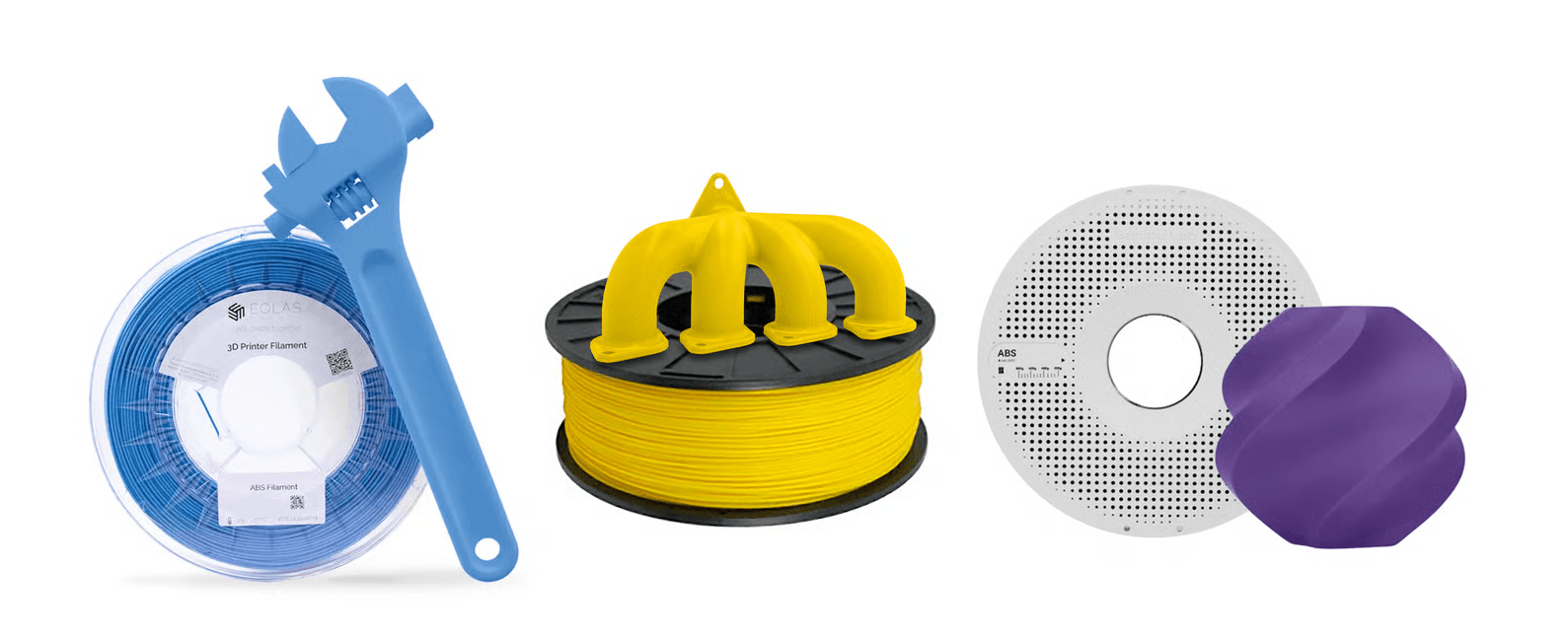
Acrylonitrile butadiene styrene butadiene (ABS) is less popular than PLA for everyday 3D printing, mainly because of its hazardous fumes. However, in terms of material properties, ABS is actually far superior to PLA, despite being more difficult to print - it's prone to warping without a hot print bed and bed adhesive.
Commonly used in injection molding, ABS is found in many household and consumer products, including LEGO bricks and bicycle helmets.
Products made from ABS are characterized by high durability and the ability to withstand high temperatures, but 3D printer enthusiasts should be mindful of the filament's high printing temperature, tendency to warp during cooling, and potentially dangerous fumes. Be sure to print with a heated bed and in a well-ventilated space (or enclosure).
There are other variations of ABS filament, each with specific properties tailored to different printing needs. For example, ABS-CF is an ABS reinforced with carbon fiber. Filament 3D Printers
ABS is durable and can withstand high stresses and temperatures. It is also moderately flexible, although there are certainly better options for this aspect further down this list. Together, these properties make ABS a good filament for general-purpose 3D printers, but where it really excels is with items that are handled, dropped, or heated frequently. Examples include phone covers, high-wear toys, tool handles, automobile trim parts and electrical enclosures. 3d printer filament
| Own | Value |
|---|---|
| Resistance | Retrieved |
| Flexibility | Average |
| Durability | Retrieved |
| Difficulty of use | Average |
| Printing temperature | 210 - 250 °C |
| Bed temperature | 80 - 110 °C |
| Shrinkage/deformation | Considerable |
| Solubility | In esters, ketones and acetone |
| Food safety | Not food safe |

PETG (polyethylene terephthalate glycol) is a widely used 3D printing filament known for its balance between strength, flexibility and ease of use. It is a modified version of PET (the plastic used in water bottles) with added glycol to reduce brittleness and improve clarity and durability. PETG combines the best features of PLA and ABS, making it a versatile material for a wide range of applications.
PETG is semi-rigid, impact resistant and has good chemical and moisture resistance. It offers better durability and strength than PLA while being easier to print than ABS. PETG is also less prone to warping, which means it generally does not require a closed printing chamber. It prints at moderate temperatures (typically 220 °C-250 °C) and adheres well to the print bed with minimal shrinkage. In addition, it is food safe (in some formulations), recyclable and available in clear or colored versions.
Three things 3D printing enthusiasts should keep in mind when using PETG:
PETG is „hygroscopic”, which means it absorbs moisture from the air. This has a negative effect on the printability of the material, so be sure to store your 3D printer filament in a cool, dry place and, if necessary, dry it before use.
PETG is sticky when printed, which makes this 3D printer filament an unsuitable choice for support structures, but good for layer adhesion.
Although not brittle, PETG scratches more easily than ABS. 3d printer filament
PETG is a versatile material, but it stands out from many other types of 3D printer filament due to its flexibility, strength and resistance to high temperatures and impact. This makes it an ideal 3D printer filament that can be used for functional objects that may be subjected to sustained or sudden stresses, such as mechanical parts, printer parts and protective components. Recycled PETG, made from old water bottles and other sources, is even better for the environment. 3D printer filament
| Own | Value |
|---|---|
| Resistance | Retrieved |
| Flexibility | Average |
| Durability | Retrieved |
| Difficulty of use | Low |
| Printing temperature | 220 - 250 °C |
| Bed temperature | 50 - 75 °C |
| Shrinkage/deformation | Minimum |
| Solubility | No |
| Food safety | See manufacturer's recommendations |

Acrylonitrile styrene acrylate (ASA) is known for its high impact strength and chemical resistance, but it was developed mainly for one purpose: outdoor use. It has high UV resistance, rigidity, high heat resistance and high chemical resistance. ASA resists fading outdoors.
It is the easier to print version of ABS, but also requires high extruder and bed temperatures and an enclosure to counteract warping, cracking and shrinkage. It's certainly not suitable for all printers, but can be used by the higher performance desktop printers and, of course, industrial FDM printers.
Although it can be expensive to buy and difficult to print, the quality of ASA makes it a fantastic filament for difficult and tough use cases. A big disadvantage of ASA is its strong and potentially dangerous fumes, so it should be used with caution.
ASA can be infused with glass and other fibers to improve rigidity.Filament 3D Printers
For everything from bird houses to customized garden gnomes and replacement outlet covers, look no further than this 3D printer filament.
| Own | Value |
|---|---|
| Resistance | Retrieved |
| Flexibility | Average |
| Durability | Retrieved |
| Difficulty of use | Average |
| Printing temperature | 240 - 260 °C |
| Bed temperature | 90 - 110 °C |
| Shrinkage/deformation | Moderate to high (closure/closure recommended) |
| Solubility | No |
| Food safety | Not food safe |
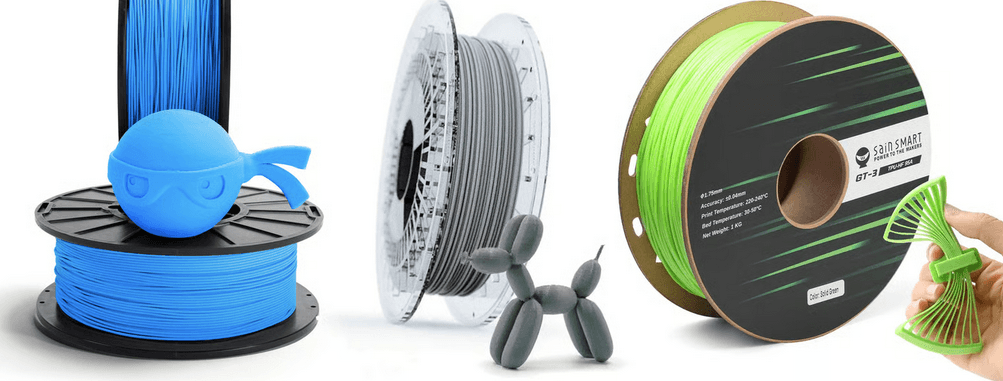
TPU (thermoplastic polyurethane) is a flexible, rubber-like filament used in 3D printing, known for its elasticity, durability and impact resistance. It belongs to the broader category of TPEs (thermoplastic elastomers), but TPU is by far the most widely used variant in 3D printing due to its excellent printability and mechanical strength.
Unlike rigid filaments such as PLA or ABS, TPU can bend, stretch, compress and absorb shock, making it ideal for functional parts that need to withstand wear or mechanical stress.
TPU requires some adjustments compared to stiffer filaments. Its flexible nature makes it prone to threading and leakage, especially at higher speeds. For best results, TPU is usually printed slowly - at about 20 to 30 mm/s - and works best with direct-actuated extrusion, which provides better control of the filament path. Bowden-type extruders can still work, but often require more adjustment to prevent blockage or inconsistent flow.
TPU is commonly used in applications where flexibility and strength are essential. These include phone covers, protective covers, gaskets, seals and customized grips. It's also preferred for producing vibration dampening components such as drone bumpers, RC car tires and suspension parts. Other creative uses include wearables such as shoe soles and watch straps, as well as ergonomic tools and soft enclosures for electronics.
Although TPU does not perform well in high temperature environments and may not have the dimensional accuracy of rigid plastic, it excels in scenarios that require a balance between flexibility, strength and longevity. For manufacturers and engineers who need durable and flexible parts, TPU offers a reliable and versatile solution once the settings are configured.Filament 3D Printers
Use flexible filaments when creating objects that need to withstand heavy wear and tear. If the 3D printed part bends, stretches or compresses, these 3D printer filaments should be suitable for the task. Examples of prints can include toys, phone covers or wearable accessories (such as bracelets). TPC can be used for similar applications, but performs very well in harsher environments, such as outdoors, or anywhere it will be exposed to high heat, such as in a car.
| Own | Value |
|---|---|
| Resistance | Average |
| Flexibility | Very high |
| Durability | Very high |
| Difficulty of use | Medium (TPE, TPC); Low (TPU) |
| Printing temperature | 220 - 250 °C |
| Bed temperature | 40 - 60 °C (but not compulsory) |
| Shrinkage/deformation | Minimum |
| Solubility | No |
| Food safety | Not food safe |

Nylon, also known as polyamide (PA), is a popular family of synthetic polymers used in many industrial applications and excels where strength and durability are essential requirements.
As the capabilities of 3D printers improve - with better hotends, enclosed chambers with better temperature control, and humidity-controlled filament stations - it's easier to avoid the challenges that plague nylon printing, such as warpage and moisture issues. Nylon has become more affordable. It opens up a new level of performance that PLA simply can't match, whether you're building functional prototypes or end-use replacement parts.
There are many types of nylon, ranging from bio-sustainable nylon made from castor oil at one end of the nylon spectrum to fossil fuel-based nylon at the other. Nylon can be enriched with glass fibers, carbon fibers and Kevlar. There is specially formulated high temperature nylon and even nylon recycled from commercial products, including discarded fishing nets. There is PA6, PA6/66, PA11 and PA12, with prices ranging from 300 lei per kg to over 850 lei per kg.
Nylon, like PETG, is hygroscopic, which means it absorbs moisture, so remember to store it in a cool, dry place to keep the filament in optimal condition, ensuring better quality prints. Filament 3D Printers
Taking advantage of nylon's strength, flexibility and durability, this type of 3D printer filament can be used to create tools, functional prototypes or mechanical parts (such as hinges, buckles or gears).
| Own | Value |
|---|---|
| Resistance | Very high |
| Flexibility | Retrieved |
| Durability | Retrieved |
| Difficulty of use | Average |
| Printing temperature | 240 - 260 °C |
| Bed temperature | 70 - 100 °C |
| Shrinkage/deformation | Considerable |
| Solubility | No |
| Food safety | See manufacturer's recommendations |
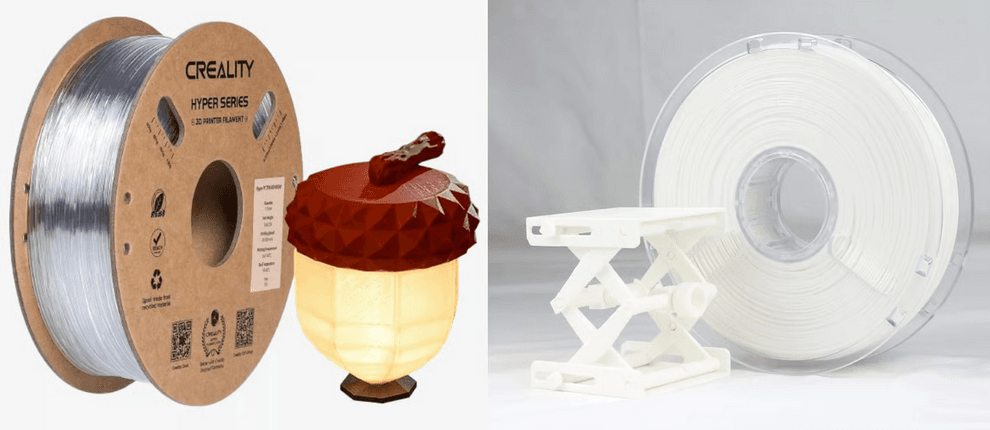
Polycarbonate (PC), in addition to being one of the strongest 3D printer filaments featured in this list, is extremely durable and resistant to both physical impact and heat, with the ability to withstand temperatures up to 110 °C. Used by hobbyists for printing lamps and lighting fixtures, it is also widely used in engineering, manufacturing and industrial applications because it is strong and able to withstand mechanical stress and repeated use without cracking or warping.
Polycarbonate is not easy to print on standard desktop printers. It usually requires a high nozzle temperature between 260 and 310 °C and a platform heated to above 90-100 °C. The use of an enclosed or actively heated print chamber is strongly recommended to reduce warping and layer separation. In addition, since the material is hygroscopic, it should be stored in a dry environment to avoid moisture absorption, which can compromise print quality.
Because of its physical properties, PC is an ideal filament for 3D printers for parts that need to retain their strength, toughness and shape in high temperature environments, such as electrical, mechanical or automotive components. You can also take advantage of its optical clarity for lighting designs, displays and other applications that require transparency. It's also commonly found in protective equipment such as visors, safety visors and impact-resistant covers. The material's optical clarity makes it suitable for lighting applications, while its excellent insulating and flame retardant properties (in certain blends) make it a reliable choice for electronic enclosures.
| Own | Value |
|---|---|
| Resistance | Very high |
| Flexibility | Average |
| Durability | Very high |
| Difficulty of use | Average |
| Printing temperature | 270 - 310 °C |
| Bed temperature | 90 - 110 °C |
| Shrinkage/deformation | Considerable |
| Solubility | No |
| Food safety | Not food safe |

Polypropylene (PP) is excellent for applications requiring light weight, tightness or durability. Food or liquid containers as well as clamps and closures that bend repeatedly are popular uses. Although PP is considered a food-safe material, keep in mind that food safety in 3D printing outweighs the properties of the filament material.
PP printing has its peculiarities, so let's explore how to print and store this material. After that, we'll give you some good options if you want to source your own filament.
Unfortunately, PP is notoriously difficult to print, often exhibiting strong warping and poor layer adhesion. If it weren't for these problems, PP could compete with PLA and ABS for the most popular types of filament for 3D printers, given its strong mechanical and chemical properties.
PP can be mixed with carbon fiber to increase the rigidity of the prints.
If you can control the deformation of PP, then most prints that require a strong, lightweight material would be suitable for PP. It's important to note, however, that although the material is widely used in packaging of consumables and medicines due to its food-safe properties, the FDM 3D printing process negates this advantage as there are hundreds (if not thousands) of lines of layers where bacteria can accumulate - best not to try.
| Own | Value |
|---|---|
| Resistance | Average |
| Flexibility | Retrieved |
| Durability | Retrieved |
| Difficulty of use | High (poor grip on the bed, warping) |
| Printing temperature | 220 - 250 °C |
| Bed temperature | 85 - 100 °C |
| Shrinkage/deformation | Retrieved |
| Solubility | No |
| Food safety | Variable, often food-safe-consult manufacturer |

PEEK belongs to the polyaryl ether ketone (PAEK) family of polymers and is enjoying growing popularity for applications in the military, pharmaceutical, petrochemical, medical, food packaging and petrochemical industries.
However, its high cost and difficult processing limits it to industrial use with specific printers. PEEK is less than half the weight of aluminum and one-sixth the weight of steel, making it an excellent metal replacement for parts in the oil and gas and aerospace industries. PEEK's properties can be further improved by combining it with composite materials such as fiberglass, graphite or carbon reinforcements, which help combat shrinkage.
PEEK is also used for medical implants (as it is fully biocompatible and X-ray transparent), but there is a huge difference between industrial PEEK and implantable PEEK, with Evonik offering the only fully medically approved PEEK filament on the market so far (at a price of around 5,000 USD/kg).
PEEK is highly resistant to extreme temperatures up to 260 °C and to corrosive fluids, gases and high pressures. It can be repeatedly sterilized and maintains its dimensional stability.
PEEK is often used for printing lightweight, high-strength components that can withstand heat and stress, such as brackets, pipes and housings. In the automotive industry, it is used for engine compartment parts exposed to oil, fuels and high temperatures, replacing metal components to reduce weight without compromising durability.
In the medical field, PEEK is used for custom implants, surgical instruments and dental applications because it is biocompatible and sterilizable. It can be tailored to specific patient needs while maintaining structural integrity in clinical environments. In electronics, PEEK's excellent electrical insulation and wear resistance make it ideal for connectors, insulators and components used in harsh or high voltage environments.
Manufacturers also rely on PEEK in the production of tools, devices and accessories that must maintain dimensional stability during repeated use at high temperatures. Due to its outstanding properties, PEEK is chosen when other filaments such as ABS, nylon or even polycarbonate would not be suitable. However, printing with PEEK requires a high-temperature 3D printer with a heated chamber and specialized handling, which limits its use to advanced industrial or research environments.
| Own | Value |
|---|---|
| Resistance | Very high |
| Flexibility | Average |
| Durability | Very high |
| Difficulty of use | Very high (specialized printer required) |
| Printing temperature | 360 - 400 °C |
| Bed temperature | 120 - 160 °C |
| Shrinkage/deformation | Very high (closed heated room is essential) |
| Solubility | No |
| Food safety | Often biocompatible and FDA compliant, but check with the manufacturer |
Add Capib.ro as a trusted source in Google search results
Capib.ro turns your 3D model into a clear offer. Rapid, no questions asked, and you know exactly from the start how much you pay.
Our configurator instantly calculates the price and delivery time—no need to wait for a response.
You pay exactly what you see in the offer—no hidden costs and no haggling via email.
Upload the file, get a quote, and place your order—all directly from your browser, without any software.
We work with FDM, SLA, and SLS, using more than 20 different materials—for any project, from a single prototype to mass production.