SLS 3D printing: precise tolerances, complex geometries.

For functional applications requiring high strength, precision, fine surfaces and top chemical resistance.
Automotive

Engineering

Aerospatial

Manufacturing

Medical

Research

Energy

PA12 powder for functional applications, with high mechanical strength, excellent dimensional accuracy, fine surfaces and superior chemical resistance with SLS and MJF 3D printing.
Selective Laser Sintering Technology
Selective Laser Sintering is a revolutionary additive manufacturing method that enables the creation of complex parts by multi-agent printing.
1. Sintering
The laser beam scans the cross-section of the part, melting and fusing the polymer powder particles into a digital pattern.
2. Stratification
The platform lowers with one layer unit and the dispensing system applies a new uniform layer of pre-heated powder on top of the previous one.
3. Cooling and Cleaning
After controlled cooling by 12 to 24 hours (required for dimensional stability), the part is removed from the powder block and cleaned.
Capib.ro uses Formlabs Fuse 1 printer and PA12 powder.


Instant price - in three steps.
1. Upload the 3D model into our app.
2. Choose the right material.
3. Place your order.

3D printing SLS MJF Polyamide PA12
The technology of SLS MJF 3D printing provides parts with excellent chemical resistance, biocompatibility and weather durability. Ideal for functional components requiring geometric accuracy and UV stability.
Grey Brut
Standard option immediately after production. Matt, fine granular appearance. The most economical option.
Charcoal Gray
The pieces are sand-blasted to remove excess powder, resulting in a much smoother and even surface.
Matte Black
Professional dip painting. Provides a premium aesthetic look, ideal for end-user products.
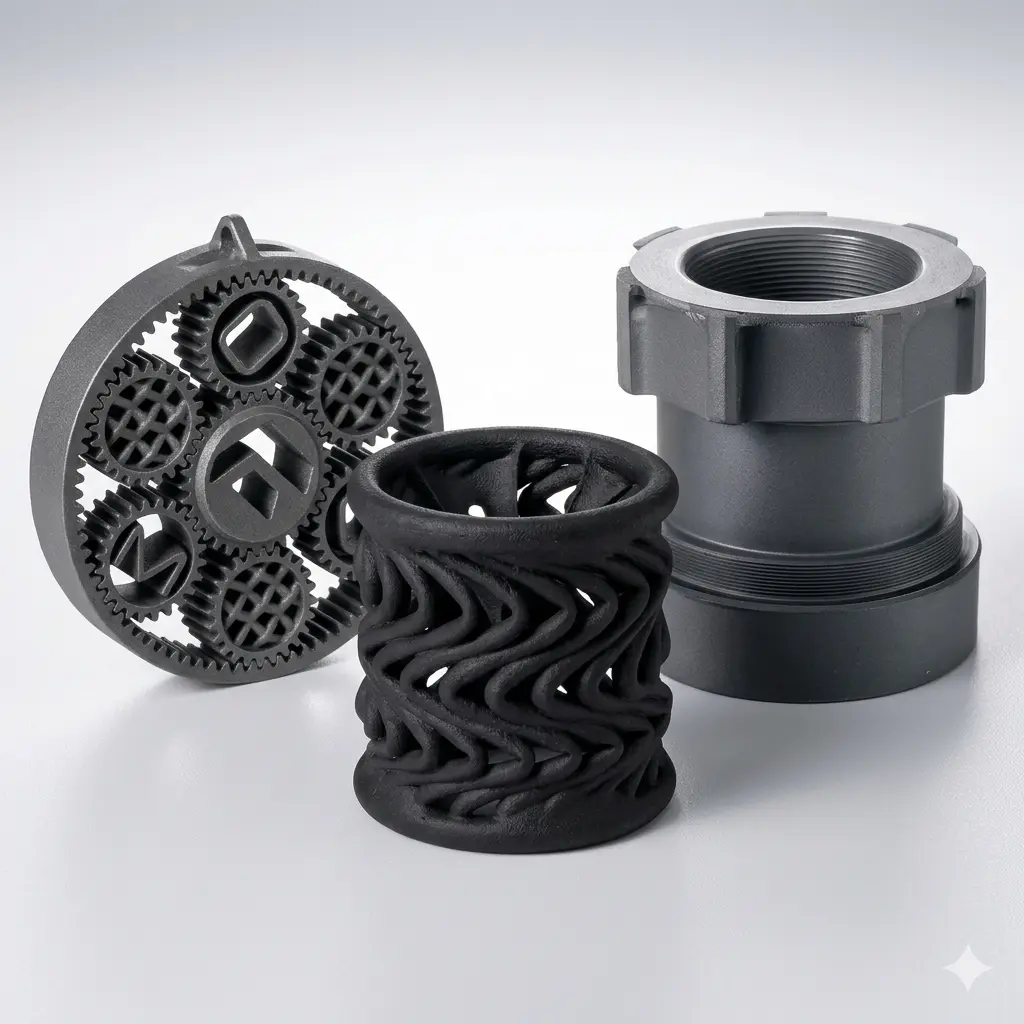
Comparative image: Left (Matte Black) | Center (Charcoal Gray) | Right (Raw Gray)
Star Material: PA12 (Polyamide)
Design Freedom
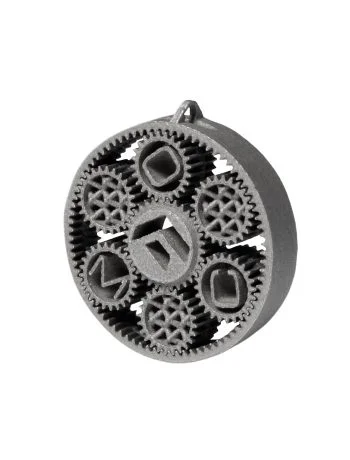
We can print complex „one-in-one” designs (e.g. chain links), directly assembled, eliminating the need for technical support.For All
High accuracy and low cost make the technology accessible to both beginner and professional designers.Efficiency Without Equals
10 TIMES FASTERthan FDM or SLS technologies. The ideal choice for rapid prototyping and small- to medium-volume production.Trusted partner
for
industry leaders
and engineering




What is SLS and MJF 3D printing and what is the difference between them?
At Capib, we use industrial SLS (Selective Laser Sintering) and MJF (Multi Jet Fusion) technologies to produce strong and precise parts without supports. SLS uses a laser to sinter nylon powder layer by layer, ideal for complex geometries and functional prototyping. MJF uses fusion and detailing agents along with heat to create more uniform parts with consistent mechanical properties.
Overall, MJF is faster and more efficient for mass production, while SLS offers greater design flexibility.
What types of materials are available for SLS and MJF printing?
We mainly use nylon (PA12), a technical material recognized for its high mechanical strength, flexibility and dimensional stability. It resists wear, impact and chemicals, making it ideal for functional parts and industrial applications. Depending on the design, variants with improved properties such as increased stiffness or thermal resistance may also be available.
Which applications are suitable for SLS and MJF 3D printing?
SLS and MJF technologies are commonly used for functional prototypes, product enclosures, mechanical components, spare parts and even final products. At Capib, they are ideal for industries such as automotive, engineering, product design and electronics, where a combination of strength, precision and design freedom is required.
How accurate are SLS and MJF 3D printed parts?
The accuracy of parts made by SLS and MJF is generally about ±0.2-0.3 mm, depending on size and complexity. At Capib, we optimize the orientation and printing parameters to obtain the most accurate and repeatable results, essential for technical applications and production.
Is SLS or MJF printing suitable for functional parts?
Yes, these technologies are among the most suitable for functional parts due to their high mechanical strength and homogeneous material structure. Parts produced at Capib can be used in real working environments, withstanding mechanical stress, vibration and wear over time.
What is the finish of SLS and MJF parts?
The parts have a matte, slightly textured finish, specific to powder-based technologies. At Capib, we also offer post-processing services such as sandblasting, smoothing, painting or special treatments to improve the appearance and performance of the parts.
What is the delivery time for SLS/MJF 3D printing?
Delivery times vary according to complexity and volume. At Capib, prototypes can be delivered in a few days, while larger orders or production runs can take 1-2 weeks. We also offer consultancy to optimize lead times.
What are the advantages of SLS and MJF 3D printing over other technologies?
The main advantages include the lack of supports, high mechanical strength, the possibility to realize complex geometries and cost efficiency for small series production. In addition, parts are more durable compared to FDM or SLA technologies.
Do you need supports in SLS or MJF printing?
No, because the unused powder supports the part during the printing process. This allows for complex shapes and reduces the need for post-processing.
What is the maximum size of printed pieces?
The maximum size depends on the equipment used, but in general Capib can produce parts up to about 300-380 mm. For larger objects, parts can be split and assembled later.
How much does SLS or MJF 3D printing cost?
Cost is influenced by part volume, complexity, material and quantity. At Capib, we offer fast estimates and competitive prices, and significant discounts for mass production.
Can I order a single piece or just mass production?
Capib accepts both one-piece orders and series production. This allows customers to start with prototypes and then scale up to production.
What file formats are supported for 3D printing?
We support standard formats such as STL, STEP and 3MF. The Capib team can check and optimize files to prevent errors and ensure the best part quality.
Is MJF printing faster than SLS?
Yes, MJF is generally faster and more efficient for volume production as it processes multiple parts simultaneously and provides high consistency between parts.
Do you offer design consultancy (DfAM)?
Yes, we offer DfAM (Design for Additive Manufacturing) consultancy to optimize part geometry, reduce costs and improve performance. This helps achieve better results right from the design phase.