
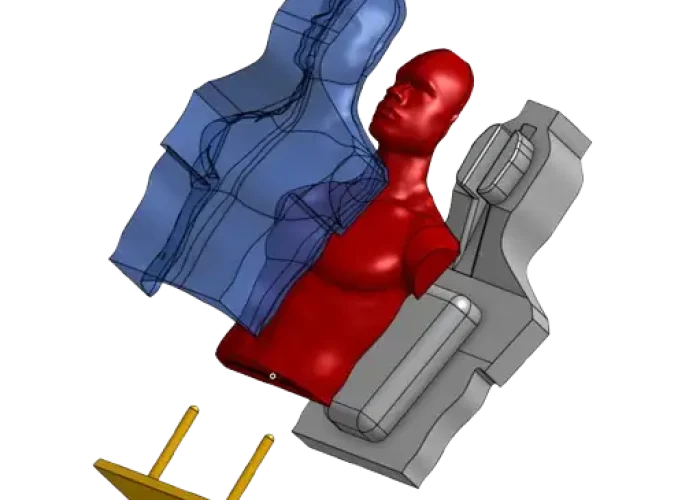
You can choose between a quote for an injection mold and a quote for 3D printing. The mold requires an initial investment of approximately 19.640 € and a low cost per part, whereas 3D printing costs more per unit but does not require dedicated tooling. The right question is not just when injection molding becomes cheaper per part, but when the return on investment offsets all the project’s risks.
For new products, small batches, technical parts, or geometries that may change, 3D printing is often the more efficient choice. For very large volumes, stable designs, and predictable demand, injection molding may be the better option.
A Simple Break-Even Point Calculation
The basic formula is:
Mold cost ÷ (3D printing cost per part − injection molding cost per part)
In a real-world example, a mold costs approximately 19.640 €, a 3D-printed part costs 3,04 €, and the same injection-molded part costs 0,76 €. The result is:
19,640 € ÷ (3.04 € − 0.76 €) ≈ 8,600 pieces
At first glance, it seems that injection molding becomes cost-effective after a few thousand units. The math is correct, but it doesn't account for the full cost of the decision. In practice, the actual break-even point may be much higher.
Four Factors That Change the Outcome
1. Time until the first tracks
A mold of medium complexity may require approximately 8–16 weeks From the initial order to the first injection-molded parts. 3D printing can deliver the first prototypes in a matter of days. If you need to present the product, test the assembly, or start sales in less than six weeks, a mold isn’t necessarily more expensive—it may simply be too slow for the project.
2. Design Changes
With a new product, the first version is rarely the final one. Modifying a mold can cost approximately €1,790–7,140, and a significant change in geometry may require a new mold. For a 3D-printed part, making a change usually involves updating the CAD model and uploading a new file.
If you expect two or three service visits in the first year, the cost of that flexibility should be included in the comparison from the start.
3. Inventory Risk
A mold recoups its investment through the production of large batches. This may mean purchasing months’ worth of inventory before you know whether the product will sell at the estimated level. 3D printing allows you to produce based on actual demand: this month, you manufacture only what you need for this month.
Unsold inventory isn't just money tied up. It also means storage space, the risk of product changes, and the possibility that the next version will render the old parts obsolete.
4. Cash Flow
The cost of the mold is paid before the first parts generate revenue. In our example, it is approximately 19.640 € initial investment. 3D printing functions more as an operating cost that is paid as orders come in.
Two options with the same total cost over four quarters do not have the same impact on a company if one requires the entire amount in the first week and the other spreads the payment out over time.
Where does the actual break-even point lie?
Once you factor in delivery time, redesign risk, inventory, and cash flow, the actual break-even point usually shifts beyond the simple calculation:
| Type of play | Simple calculation | Effective Indicative Threshold | The usual choice below the threshold |
|---|---|---|---|
| Packaging for consumer products, with possible revisions | 5,000–10,000 pieces | 25,000–40,000 units/year | 3D Printing |
| Mechanical parts with stable geometry | 8,000–15,000 pieces | 30,000–60,000 units/year | 3D printing; injection molding becomes competitive at around 30,000 if the design is finalized |
| Small-batch industrial, aerospace, or defense parts | It is usually not touched | Rarely found in standard volumes | 3D Printing |
| Mass-produced parts with a reliable design, over 100,000 per year | — | — | Injection molding |
When does injection molding clearly come out on top?
An injection is the right choice when three conditions are met:
- you need more than 100,000 identical parts per year;
- The design has been reviewed and no further changes are needed;
- You're using a standard thermoplastic, and the 8–16-week mold lead time fits the launch schedule.
Caps, toothbrush handles, and car clips that have been manufactured for years are good examples. In such cases, material savings and the speed of the injection molding cycle can outweigh the advantages of 3D printing.
When is 3D printing most appropriate?
3D printing offers a decisive advantage when production volumes are small or uncertain, when a product is still in development, and when the time to the first part matters more than the marginal cost. It is suitable for:
- functional prototypes and assembly validation;
- small batches and custom products;
- spare parts for products that are no longer manufactured;
- technical components with complex geometries;
- launches for which demand is not yet certain.
A major advantage is that you can produce only the quantity you need, and then refine the part without having to amortize the cost of a fixed tooling. For projects that fall between prototyping and mass production, this flexibility is often worth more than the difference in cost per unit.
Conclusion: Compare the total cost, not just the price per part
The threshold of approximately 8,600 units in the baseline calculation is a starting point, not a universal rule. If you factor in execution time, revisions, inventory, and money paid in advance, the actual threshold often reaches 25,000–60,000 pieces per year.
For new products and small production runs, 3D printing reduces your risk and gives you the freedom to modify the design. If demand consistently exceeds tens of thousands of units, the design is finalized, and there is no rush to launch, it’s worth considering injection molding.
At Capib, we can help you validate the track by 3D printing before investing in a production tool. If you need design analysis and the design of a test mold, see also the plastic mold design.
Frequently Asked Questions
When is 3D printing a better option than injection molding?
3D printing is generally better suited for prototypes, small batches, customized products, replacement parts, and products whose dimensions or geometries are not yet finalized. The first parts can be delivered within a few days, without any initial investment in a mold.
At what volume does injection molding become more cost-effective?
A simple calculation suggests a threshold of approximately 5,000–15,000 units, depending on the part and the cost of the mold. After factoring in production time, revisions, inventory, and cash flow, the actual break-even point often reaches approximately 25,000–60,000 parts per year. For more than 100,000 identical parts per year with a stable design, injection molding is usually the clear choice.
How much does an injection mold cost?
In the example analyzed, a mold of medium complexity costs approximately €19,640. Subsequent modifications can cost approximately €1,790–7,140, and a major change in geometry may require a new mold. The actual price depends on the size, complexity, material, and number of cavities.
How long does it take to make a mold?
For a part of medium complexity, mold fabrication and the first prototypes typically take about 8–16 weeks. 3D printing can deliver the first parts in a matter of days, which is crucial for rapid launches and validations.
What happens if the design of the part changes?
A 3D-printing model can be modified and resubmitted quickly. In injection molding, a change may require machining the mold or creating a new one. If two or three revisions are likely in the first year, the cost and time associated with these changes should be included in the comparison.
Is 3D printing cheaper for small batches?
Most of the time, yes. 3D printing eliminates the need for tooling costs and allows for on-demand production, without having to purchase months’ worth of inventory before confirming an order. For a small production run, the total cost and risk are often more important than the minimum cost per part.
How do I choose between 3D printing and injection molding for a new product?
Compare five factors: realistic annual volume, design stability, lead time for the first parts, inventory costs, and the funds available for the initial investment. If the volume is uncertain or you need parts quickly, start with 3D printing and validate the product before moving to production tooling.
Can Capib help validate a part before it goes into the mold?
Yes. Capib can produce prototypes and small batches using 3D printing, and for projects that are close to injection molding, it can assist with design analysis and mold design for testing and prototyping. You can start with a 3D printing service or through the plastic mold design.
Add Capib.ro as a trusted source in Google search results