3D scanning
From reality to digital
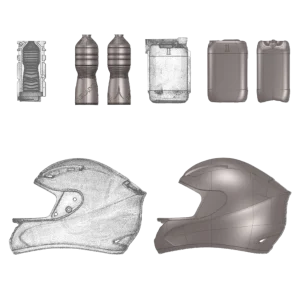
With our 3D scanning equipment we create an accurate 3D representation of your part using reverse engineering techniques.
Send the part, whether it's an assembly or a damaged part.
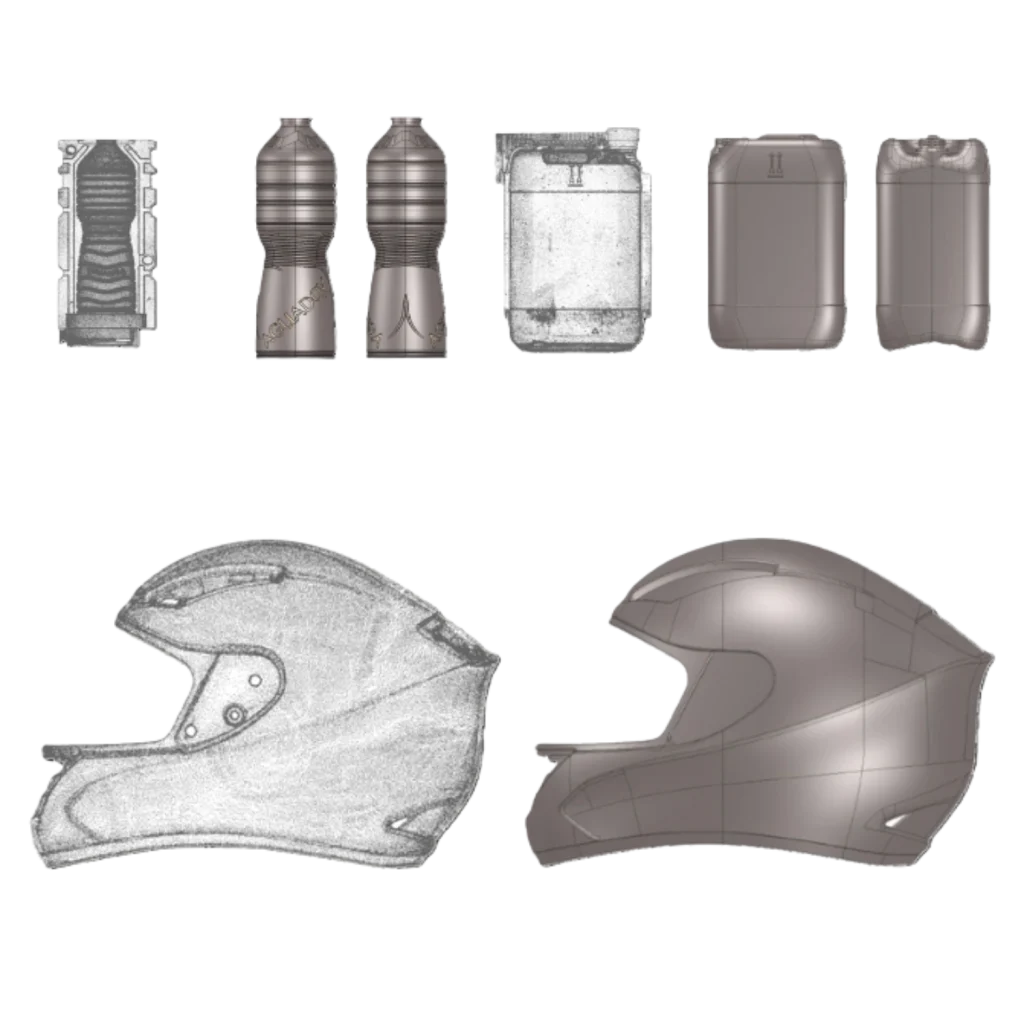
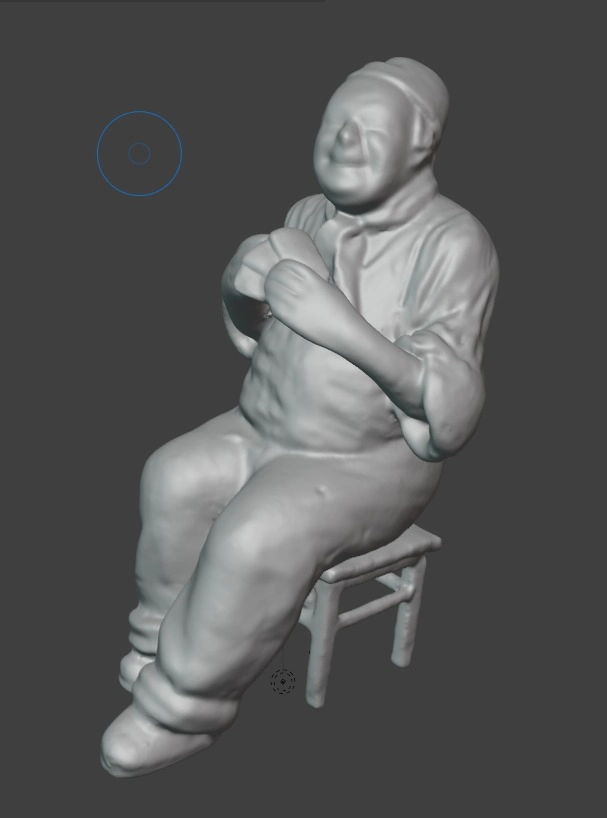
Reproductions scanned by us
We would like to show you some real images of scanned reproductions we have created for various companies and projects. From artistic projects to industrial sectors such as automotive, hospitality and engineering.
3D scanning
For parts with simple geometries.3D Design
Accurate 3D representation of your part using leading 3D CAD software.How do we do 3D scanning?
1.
Ship your part to us

2.
3D scanning
After delivery of your part, we carefully measure and analyze the geometry with our 3D scanning equipment.

3.
We design
Our team creates an accurate 3D representation of your part using state-of-the-art 3D CAD software.
Ne send ideilYour documents: sketches, technical drawings, reference imagesnance and requirements design to get us moving.

4.
We communicate
We take the 3D design and print prototypes to check the dimensions, then compare it with the original piece, send some images and a prototype to you.

Let's create your play together
Our customers.


We have successfully completed May many 3D modeling engineering projects with various practical applications.
We have successfully designed assemblies for various industries including:
- wood processing industry.
- metals industry and automation of Manufacturing and welding.
- Hotel industryă.
- Healthcare industry.
In the dynamic world of mechanical development, efficiency is paramount. Utilizing the market-leading SOLIDWORKS 3D scanning competencies, our services represent excellence in creating complete solutions and assemblies tailored to meet diverse needs. From specialized robot grippers to custom production parts, we pride ourselves on delivering production-friendly designs that optimize efficiency and minimize costs. 3d scan 3d scan 3d scan 3d scan 3d scan 3d scan
Underpinning our approach is a commitment to production-friendly design. By leveraging the advanced 3D modeling capabilities of SOLIDWORKS, we ensure that each component is meticulously designed to integrate seamlessly into existing manufacturing processes. This not only simplifies production, but also improves overall efficiency, resulting in tangible savings for our customers.
Innovation is our hallmark, and we approach cutting-edge technologies such as 3D printing to push the boundaries of what's possible. Whether it's prototyping intricate components or manufacturing production parts with unrivaled precision, our team is adept at harnessing the full potential of modern manufacturing processes. This enables us to deliver solutions that are not only superior in function, but also economically viable in the long term.
One of our key differentiators is our focus on simplicity. We believe that the best solutions are often the simplest, and our designs reflect this ethos. By reducing complex problems to simple to understand solutions, we encourage our customers to operate more efficiently and cost-effectively. This simplicity extends beyond the initial design phase, permeating every aspect of our solutions to minimize maintenance requirements and ensure long-term reliability.
Reducing operational costs is a cornerstone of our approach. Through meticulous design optimization and strategic use of materials, we strive to deliver solutions that deliver maximum performance at minimum cost. Whether it's minimizing material waste or optimizing energy consumption, we leave no stone unturned in our quest to reduce operational expenses for our customers.
What is 3D scanning and how does it work?
3D scanning is the process of digitally capturing the exact shape and dimensions of a physical object using specialized scanning equipment. The scanner collects millions of points from the surface of the object and converts them into a detailed 3D model that can be used for reverse engineering, CAD modeling, inspection, or 3D printing.
What types of objects can you scan?
We can scan a wide range of objects - from small mechanical parts to larger industrial components, prototypes, sculptures, consumer products, and custom parts. Transparent, highly reflective, or very dark surfaces may require temporary surface treatment for optimal results.
How accurate is your 3D scanning service?
Accuracy depends on the object size, geometry, and surface finish. Structured-light scanning systems can achieve accuracy as fine as 0.02 mm for detailed parts and reverse engineering applications.
What file formats do you deliver after scanning?
We can provide scan data in multiple industry-standard formats including STL, OBJ, PLY, XYZ, STEP, and IGES depending on your project requirements and intended workflow.
Can scanned models be used for 3D printing?
Yes. The scanned geometry can be converted into watertight printable meshes suitable for additive manufacturing and rapid prototyping workflows.
Do you offer reverse engineering services?
We can transform scanned geometry into editable CAD models compatible with engineering software such as SolidWorks, Fusion 360, or other CAD platforms.
How long does a 3D scanning project take?
The timeline depends on object complexity, required accuracy, and post-processing needs. Small projects may be completed within hours, while larger or more detailed projects may require several business days.
Can you scan damaged or old parts without existing drawings?
Yes. 3D scanning is commonly used for reverse engineering obsolete or damaged components where original CAD files or technical drawings are unavailable.
Will the scanning process damage my object?
No. 3D scanning is a completely non-contact and non-destructive process, making it safe for delicate, valuable, or sensitive objects.
What industries benefit from 3D scanning?
Industries including automotive, manufacturing, architecture, engineering, medical, archaeology, product design, robotics, and quality inspection frequently use 3D scanning technologies.
Can you scan large objects or environments?
Yes. Large structures, industrial facilities, buildings, machinery, and full environments can be scanned using specialized laser scanning and LiDAR equipment.
What are the limitations of 3D scanning?
Highly reflective, transparent, or hidden surfaces can be difficult to capture accurately. In some cases, temporary matte sprays or multiple scanning angles are used to improve results.
Can you help if I only have a physical object and no CAD file?
Yes. We can scan the physical object and generate a digital 3D model that can later be modified, reproduced, analyzed, or manufactured.
Do you also provide CAD modeling after scanning?
Yes. Beyond raw scan data, we offer CAD reconstruction, surface modeling, and engineering-ready deliverables for manufacturing or design workflows.
Is 3D scanning suitable for quality inspection and measurements?
Absolutely. Dense point cloud data allows dimensional verification, inspection reports, and comparison against existing CAD models with high precision.