Price for 3D scanning / redesign of plastic parts
Select the part size and see the price for 3D scanning and redesign right away.
3D scanning and redesign pricing based on part size
The price includes a 3D scan of your part and the creation of a CAD model ready for manufacturing. Assemblies or mechanisms are priced separately.
Step 1: 3D Scan
How big is your song?
Less than 10 cm
10–20 cm
Medium-sized piece — between 100 and 200 mm
Over 30 cm
Large part — we'll assess the part's complexity and get back to you with a offer custom.
Step 2: Redesign
Is your piece whole or broken?
The song is complete
It's broken — I'd like it redesigned
We reconstruct the missing section and restore the piece to its original condition, with no visible seams
It's broken — I'll glue it back together
We scan the part while it is still glued together,
Warning: With the „glued” method, you have to accept minor misalignments at the joint—the resulting piece may have a slight offset at the break, which is impossible to avoid without redesigning it.
Your Estimated Price
200 lei
Approximate prices based on an average order—larger items may cost more.
For parts larger than 30 cm, we first check the geometry and printing method—the price shown is a starting point, not a final quote.
You will receive:
3D model + STEP/STL file
Technical consultation and material selection included.
No online payment. I'll confirm the price before we get started.
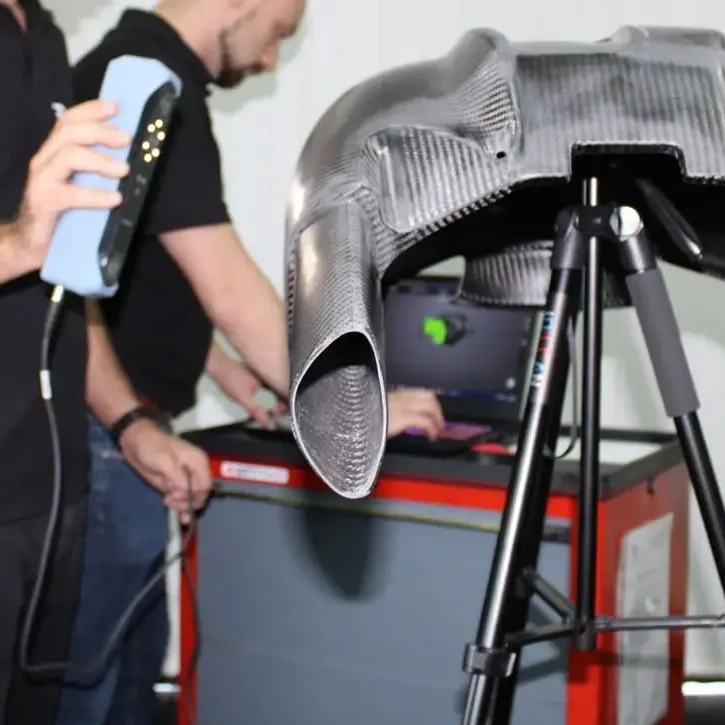
We measure the physical part and obtain its actual geometry, including any deviations.
Onshape / SolidWorks — an editable model, not a „dead” mesh.
The part is optimized for FDM: walls, orientation, supports.
Upon request, with specifications and tolerances, for production.
Physical part → 3D scan → CAD model, ready for manufacturing.
Which parts do we scan and redesign most often?
In our experience, these are generally the parts that end up with us: either they've broken, or the manufacturer no longer produces the replacement part.
Lids
Protective covers, decorative trim, fuel tank caps, or housing covers.
Clamps
Fastening clips, clips, and elastic clips that broke during installation.
Buttons
Appliance buttons, switches, levers, and control knobs.
Appliance Enclosures
Housings, grilles, and interior brackets for household appliances.
Automotive Components
Interior plastic parts, fasteners, and trim pieces that are no longer available.
Brackets
Wall mounts, desk mounts, shelf mounts, and mounts for sensors or cameras.
Gears
Gears, pinions, worms, and bushings that must fit together perfectly.
Machinery Parts
Parts from machinery and production lines that have been shut down due to a shortage of parts.
3D Scanning, CAD Redesign, and 3D Printing: What's the Difference?
There are three different stages, and they are often confused with one another. Here's what happens at each stage.
3D scanning
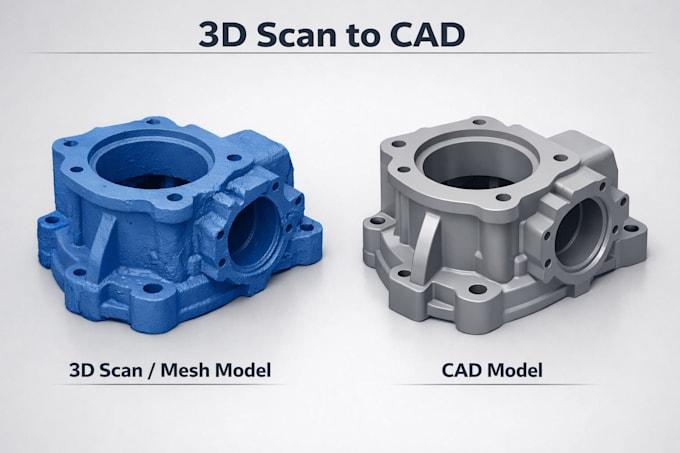
We capture the geometry. The scanner measures the part, resulting in a mesh: The shape is correct, but the surfaces are rough, with no flat faces and no perfectly cylindrical holes.
CAD Redesign
We reconstruct the play as solid in a CAD program: parallel faces, coaxial holes, exact dimensions. Here we also correct for wear, ovality, or breakage.
3D Printing
We manufacture physical piece from the CAD model, in the appropriate material: PLA, PETG, ABS, ASA, nylon, or resin. The part comes out ready for assembly.